2022年5月17日星期二

Difference between Thermoset & Thermoplastic Injection Molding


Thermoplastics and thermosetting plastics are two separate classes of polymers that are widely used in the process of injection molding to create products of various types. Both these categories of plastics possess different properties and characteristics. Hence, choosing the right category of polymer, between the two, is of paramount importance to achieve the expected results when used in applications.  Most of the injection molding service providers usually receive a question from their clients about the differences between thermoplastic and thermoset molding process. Here, in this post, let’s see thermoset & thermoplastic injection molding comparison.

Defining Thermoplastic and Thermosets

Before we go deeper into the topic, it is important to understand the two terms thermoset and thermoplastic. Let’s first find out what are thermosets and thermoplastics.

What are Thermosets?

Thermoset plastics “set” after they cure and are generally stronger than thermoplastic materials. Initially, the polymer is a liquid or soft solid, which becomes rigid later when cured. Owing to their high mechanical and physical strength, resistance to heat, corrosion, and mechanical creep, thermosets are used in a variety of applications. A few amongst the common thermoset materials used in the injection molding process include alkyds, epoxy, phenolic, polyimides, thermoset polyester, and so on.

What are Thermoplastics?

In contrast to thermoset, thermoplastics liquefy and become pliable when heat is applied. Thermoplastic polymers can be reheated and reprocessed many times, which is impossible when it comes to thermosets. Usually stored in the form of pellets prior to the molding process, these categories of polymers can withstand multiple re-shaping without causing any damage to the material. They possess high strength, shrink-resistance, flexibility, high-Impact resistance, and chemical resistant, among others. A few amongst the common thermoset materials used in the injection molding process include ABS, nylon, PET, polypropylene, polyethylene and TPE, among others.

Difference between Thermoset & Thermoplastic Injection Molding

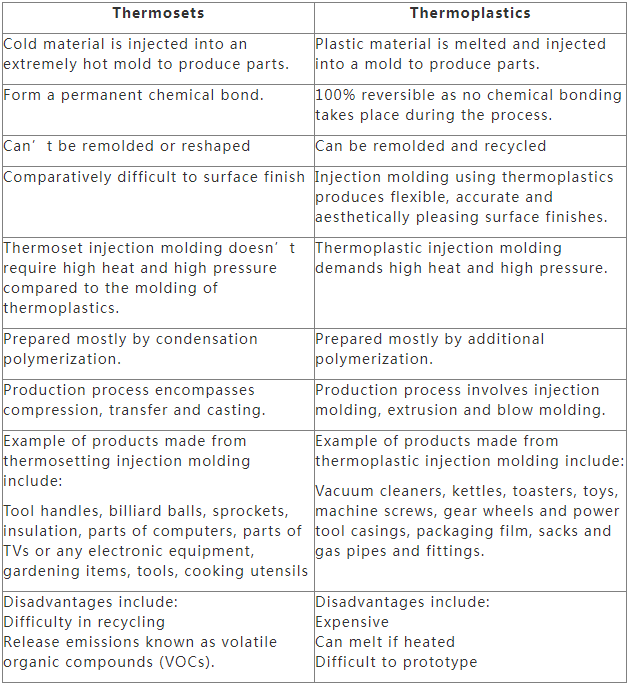
The way thermosets are molded differs with respect to thermoplastics in several aspects and both the categories require varied treatment during the injection molding process. Let’s check a few differences when molding thermosets and thermoplastics.
Where and How They’re Used

The differences inherent to thermosets and thermoplastics make them uniquely suited for differing applications.

Appliance fabrication may require a thermoset such as epoxy — the material’s high-impact resistance, microbial resistance, and general inert properties are ideal in the kitchen and cooling environment. Conversely, a thermoplastic such as polyethylene makes a great packaging film, since the material shrinks and conforms to the packaging when heated.

As a general rule, thermosets are often affiliated with manufacturing and utilities — appliances, electrical applications, and anything else involving heat that may otherwise warp thermoplastics. Thermoplastics, on the other hand, are broadly diverse and used in everything from aerospace fabrication to consumer goods and toys. The nature of the polymer used depends on the final application.


Now that you know how thermoset injection molding differs with respect to thermoplastic injection molding. With the information provided in the post, you would be able to make a judgment on the type of polymer category you should opt to produce molded parts. However, just knowing the differences between the materials won’t be enough, instead you would need an injection molding service provider who can mold your parts as per the right specifications provided. Partner with leading injection molding companies like WIT MOLD who own a comprehensive working knowledge regarding thermoplastic vs thermoset molding.

2022年4月28日星期四

What Is Thermoset Molding?


Many people are not aware of the advantages of thermoset materials. This guide describes the thermoset molding process and how it can benefit you.

*Thermoset Molding

Thermoset molding is an irreversible molding process by which malleable forms of plastic are forced into a heated mold and formed into their final shape.

Thermoplastic molding is the reverse process where heated material is injected into a cool mold. The material is then cooled to maintain the final shape of the part.

*Why Use Thermoset Molding?

Thermoset materials are generally stronger than thermoplastic materials due to the catalysts that are added to the base compound that cause chemical reactions at the molecular level, forming a harder, irreversible final form. Thermoset plastics cannot be re-melted, only ground and recycled as filler for different applications.

Thermoset molded products have electrical and thermal insulation properties, which make them ideal for electrical and electronic applications. They are resistant to corrosion and have high impact strength, depending on the resin, and are cost competitive with engineered thermoplastics. Using thermoset molding allows producers to maintain tighter tolerances during the molding process compared to similar thermoplastic materials.

*Pros of Thermoset Injection Molding

Injection molded pieces may be the best fit for a piece for several reasons:

Many different types of materials may be used in injection molding, including thermoplastic and thermosetting resins, polymers, and elastomers. This offers the engineer a great deal of control over which blend of materials will yield the best outcome, especially when needing to meet specific property requirements.

Fantastic for high-volume runs.

Precision and low waste. Because of the specific tooling and material mix, there is less waste with injection-molded parts than with other processes.

Short cooling time – Injection molded pieces cool quickly, reducing the time required to release the injected piece from the mold.

*Cons of Thermoset Injection Molding

While injection molding is a fantastic process for the reasons mentioned above, there are certain limitations and drawbacks. A few of these drawbacks include:

Tooling costs – These costs can be significant as precision crafted molds are required.

Flash – Flash is unavoidable when injection molding thermosets. Once the part has been created and ejected from the mold, an automated or manual next step is necessary to remove the flash (excess material). Flash isn’t an issue with thermoplastics due to the higher viscosity of the liquid plastic.

Part size – The size of the piece being created definitely matters when it comes to the molding process. Typically, smaller part sizes (0.1 lbs to 6 lbs) are injection molded, while larger parts are transfer or compression molded. The volume of the order will also dictate which molding process will be the best fit for the project. Compression molding would likely be used for larger parts with a low (or high) volume, while transfer molding would be used for medium to high volume projects. Injection molding would be ideal for high volume runs with smaller pieces.


WIT offers Custom Plastic Molding services. If you are interested in it, please contact us now!

2022年4月18日星期一

Two-shot molding vs. overmolding: What you need to know

Injection molding is a popular manufacturing process thats ideal for quickly creating precise parts with intricate shapes, all without leaving behind a lot of material waste. Common applications include packaging, automotive dashboards, mechanical parts like gears, and even popular kidstoys.


Many different processes fall under the umbrella of injection molding, including two-shot molding and overmolding. These two processes are similar but have a few key distinctions heres what engineers and designers need to know:


What is two-shot molding?

Two-shot molding, also known as dual-shot, multi-shot, or double-shot molding is a subcategory of injection molding that allows engineers to create multi-material or multi-colored parts without adding extra assembly steps.


The two-shot injection molding process is best understood in terms of the different layers of materials or colors that are created by the injection molding machine. The first material is injected into a mold to create the substrate, around which the other material or materials will be molded. The substrate solidifies and cools before being transferred by hand, robot arm, or rotary plane to the other chamber of the mold.


From there, the mold opens and the side with the substrate rotates 180° to meet the other mold chamber and injection molding nozzle. Once the substrate is in place, the second material is injected and bonds with the substrate to form a firm hold.  Once the second layer cools, the final part is ejected.


Engineers should know that two-shot injection molding can be sped up or slowed down based on how the substrate is transferred to the other chamber of the mold. Hand and robot arm transfers take longer than a rotary plane, but rotary platen molding is more expensive and generally only an efficient option for high volume production runs.


Additionally, its critical that molds are made out of materials that will easily bond together and that the molds align correctly to prevent deformities in the part.


Advantages and disadvantages of two-shot molding

Two-shot plastic injection molding is an excellent technique for efficient and cost-effective manufacturing. This process also produces highly durable end parts and components.


From a design standpoint, two-shot molding offers designers a lot of flexibility because this process can create complex geometries and accommodate multiple colors, making for more aesthetically pleasing parts.


Further, since one machine makes the whole part and no post-processing is required, engineers can dramatically reduce manufacturing time, which in turn keeps costs low. However, its worth noting that the initial two-shot mold costs can be high and the two-shot molding machine is more expensive than a standard injection molding machine. Luckily, these costs are often offset by labor savings and assembly costs on large production runs.


What is overmolding?

Overmolding, like two-shot molding, is a multi-shot injection molding process that produces a single end product from two or more different thermoplastics. This process is ideal for engineers who want to build strong, functional, aesthetically pleasing parts that wont separate over time.


To start the overmolding process, an engineer injection molds a substrate out of the more rigid overmold material. Then, the substrate is placed in an overmold tool or overmold cavity within the same tool. The molten overmolding material is then ejected into, onto, or around the substrate. After the molten material cools, the substrate and overmold are chemically or mechanically bonded. The entire overmolding process can take as little as 30 seconds.


Product teams must keep in mind that all thermoplastics used in the overmolding process must be chemically or thermally compatible with one another. Compatibility generally is not an issue with metal substrates because they can be used with any plastic overmold, but product teams can encounter compatibility issues when overmolding plastic with plastic. If the substrate and overmold arent compatible, the end product might be deformed or poorly bound.


However, if two plastics with less-than-ideal compatibility must be used, teams can design mechanical bonding features into the part after the fact, though this is likely to result in higher costs.


Advantages and disadvantages of overmolding

Overmolding and two-shot injection molding share many of the same advantages. Theyre both ideal for quickly creating durable, reliable, and vibration-resistant parts with complex geometries, but overmolding is best suited for low-volume production runs.


Compared to two-shot molding, overmold designs are also easier to make because engineers can use any standard injection molding machine to conduct this process.


In terms of disadvantages, the tolerances of parts made via overmolding are often inferior to those that can be achieved with two-shot injection molding. Its also important to remember that plastic compatibility requirements can constrain designers.


Choosing between two-shot molding and overmolding

Two-shot molding and overmolding are both simple and effective processes for creating durable parts made of two or more materials or two or more colors. To choose between the two, engineers should consider the size of their production run.


Two-shot molding usually only makes sense for larger production runs, whereas overmolding is better for low volume production runs. Still, teams must do their due diligence and evaluate all critical considerations of each potential manufacturing process against their specific project requirements to ensure theyre making the right choice.


2022年3月23日星期三

Three Questions You Need to Consider before Choosing Precision Molding


If you need a plastic part molded with extreme precision—for example, to ensure there’s no air leak between two molded sections or to be certain there’s no visible seal gap line—you likely require precision molding. The difference between a typical injection molded part and a precision molded part is the tolerance, or acceptable range of variation in dimension: While the majority of injection molded parts have a tolerance of +/- .005″, precision molding holds tolerances between +/- .002″ and +/- .001″ (or less, in some cases).

Let’s say, for example, you’re planning to manufacture a military projectile. In order for the projectile to fit properly in the firearm, handle the acceleration when it’s launched, and explode on impact, it requires very high precision.

If your application requires precision molding, you can’t leave anything to chance—so you’ll want to ask yourself the following three questions before you begin the process:

1. Have you selected a plastic material with low shrinkage?

The plastic material you select for your part makes a big difference in whether you’ll be able to do precision molding. For example, polypropylene has a shrinkage range of +/- .014″ to +/- .022″, with an average of +/- .018″. This is a wide range for shrinkage, which makes hitting a specific tolerance extremely difficult. If you’re molding a toothbrush (which commonly uses polypropylene), dealing with shrinkage isn’t a big concern, as the toothbrush will function appropriately regardless of whether it’s slightly bigger or smaller than its counterparts. Acrylonitrile butadiene styrene (ABS)—another common thermoplastic polymer—has a much narrower shrinkage average of +/- .006″. That gives you a much better chance of hitting a tighter tolerance, but it still won’t reach the +/- .001″ or +/- .002″ tolerance needed for a precision part.

One way to hit high tolerances with your plastic material is to add glass or another filler resin (like carbon fiber or mica) into the material. This can minimize shrinkage and warp by providing more structure in the material. For example, if you include long glass fibers in a polymer material, the part will shrink more perpendicular to those fibers.

2. Have you determined which areas of the mold require precision?

Because precision molding is more expensive than typical injection molding, be certain which aspects of your part require tight tolerances—and whether those tolerances can be achieved through injection molding—before moving forward. For example, a surgical handle may only require precision for the piece that will connect with a pin, not the entire handle. Identifying your precision requirements from the get-go ensures you’ll get what you need without wasting money. In the case of the surgical handle, your injection molding partner may advise you to add the tolerances you need through tooling after the injection molding process is complete.

3. Can the mold manufacturer you’ve selected tool with high precision?

The process of creating plastic parts with tight tolerances begins with a high-precision mold. If each plastic part you create is not identical, you won’t have a precise product—and a precise mold ensures there’s no variation for each part. Because of this, it’s extremely important to select a mold manufacturer who understands the slow, steady process of building a high-precision tool. Keep in mind that selecting a mold manufacturer that specializes in rapid tooling is likely not your best option, as the goal of rapid tooling is to finish the mold quickly—but not necessarily precisely.

Let’s get your precision molding project started

We have years of experience in precision molding, and would love to answer any and all of your questions. You can either contact us with those questions, or, if you’re ready to get your project started now, simply contact us and request a free quote.

2022年3月9日星期三

The Ultimate Guide to Gas Assist Injection Molding


What is Gas Assist Injection Molding?

Gas assist injection molding (GAIM) is an enhanced injection molding process often applied for complex parts, large parts and parts requiring an attractive, cosmetic finish.

The types of parts benefiting most from this process include:

  • large panels
  • enclosures
  • handles
  • doors and bezels
  • tube or rod-shaped parts

How Does Gas Assist Work?

The gas assist process is introduced at the finish of the mold filling stage while the resin is still liquid.  Pressurized gas (usually nitrogen) is used in place of pack pressure from the molding machine.  The pressure from the gas completes the filling of the mold cavity, forcing an even distribution of molten resin against the mold. The gas is held inside during the entire cooling phase and then is vented, leaving a hollow void.  For internal gas-assist molding, the void is inside the plastic.  For external gas assist molding, the void is on the outside surface, typically the backside of a part.

Benefits with Gas Assist

The gas-assist process gets results when part design elements make the part difficult to manufacture using straight injection molding.  GAIM allows for more design flexibility while still being able to provide these benefits:

  • Thin-walled parts with greater strength and rigidity
  • Creation of hollowed out areas, reducing part weight
  • Reduction of molded-in stress for improved dimensional stability
  • Better surface finish with no sink marks
  • Less part shrinkage and reduced warpage

Design Advantages with Gas Assist

1. Complex Designs

For the design engineer, using GAIM expands design options and helps to minimize design changes to make the part manufacturable using injection molding. One of the greatest benefits is the ability to produce complex parts.  Oftentimes with straight injection molding, parts having different wall thicknesses are molded separately and assembled later.

GAIM allows multiple parts to be combined into one, reducing the need for secondary assembly processes – even if the parts have different wall thicknesses.  This is because gas-assist allows heavy wall sections to intersect thinner ones. Support ribs and bosses can achieve tighter tolerances and be designed larger without fear of sink marks. Gas channels are directed toward these areas and the consistent pressure during the cooling phase eliminates sink marks, associated with these support features, on the front side of the part.

2. Metal Replacement

Gas-assist allows the production of thin-walled components that have solid but hollow areas.  The resulting strength and lightweight part can often replace metal fabricated or die cast parts, and reduce product cost.

3. Large parts

The introduction of gas pressure aids in mold filling, providing uniform pressure throughout the part that lasts through the cooling stage. The result is a part with less shrinkage and reduced warpage. Part weight can also be reduced by creating hollowed out areas.

4. Cosmetic finishes

Where an attractive finished surface is required, gas-assist prevents sink areas that eliminate or at least minimize secondary operations to improve part appearance including sanding and priming.

5. Hollow parts

The gas can create hollowed out areas within parts like handles, which decreases part weight and still provides strength.


Gas Assist Molds


Cost Benefits with Gas Assist

1. Extended Tool Life

With gas-assist, lower clamping force is required because lower pressures are used.  This results in less mold wear extending the life of the tool.

2. Less Energy Cost

With lower clamping force required, larger molds can be used in smaller presses.  Smaller presses consume less power and help to decrease the cost of manufacturing the part.

3. Less Machine Time

A more rapid cooling period helps to reduce cycle time which in turn lowers manufacturing expense per part.

4. Lower Material Cost

Less material is used to produce the part because hollow areas inside of the part are created with the gas and with less resin used, the part cost is lowered.

5. Quality Results

With gas-assist injection molding, the process is typically easier to control than conventional injection molding. A dependable, repeatable process provides consistent production results and less waste.

Common pitfalls

There are many common pitfalls when it comes to Gas Assisted Injection Moulding. Firstly, it is more complex and more expensive to set up than ordinary injection molding. if the tooling price of injection mold shocks you, gas-assisted injection molds will blow you away. Also, by introducing gas into the molding mix, this variable must be precisely tracked, managed and controlled. Without experienced machine operators and technicians, the molding process could go disastrously wrong. The control of the gas also contributes to variable wall thicknesses, especially in tight corners and this is something you generally want to avoid.

Gas Assist Tool Design

If you want to achieve high-quality results, make sure you get the tool design right.

Regardless of what injection molding process will be used, it is important to engage your molder during the early stages of part design in the design for manufacturing (DFM) phase. Tooling cost, timeline, and resulting part quality will be directly impacted by the quality and efficacy of the tool.  When determining the optimal way to mold apart, engineers will consider all product requirements including application, resin selection, and cost considerations. Mold flow analysis is used to find design constraints so that adjustments can be made. When the tooling engineer determines gas-assist is the best solution, the tool will be designed with gas channels built into the mold that will allow the addition of nitrogen gas during the molding process. Determining your molding method early will conserve tooling costs and help to maintain project timelines.  Getting your molder involved early will be critical to a cost-effective, high-quality product.


To learn more about this process or to receive assistance with your project, contact WIT MOLD.

Inserted Molding Tools: Precision Solutions for High-Performance Plastic Components

  Inserted molding tools play a critical role in modern plastic manufacturing, enabling the integration of metal or other rigid inserts dir...